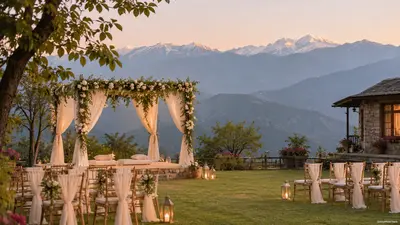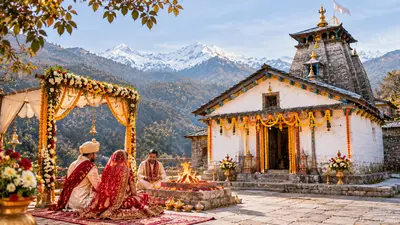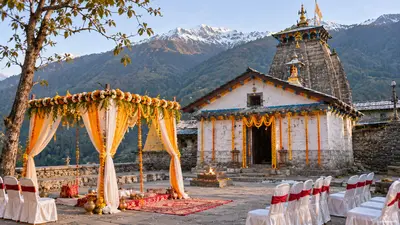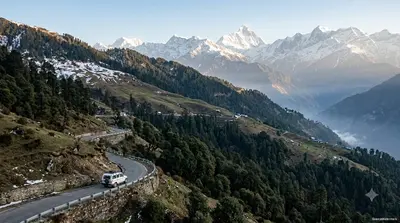
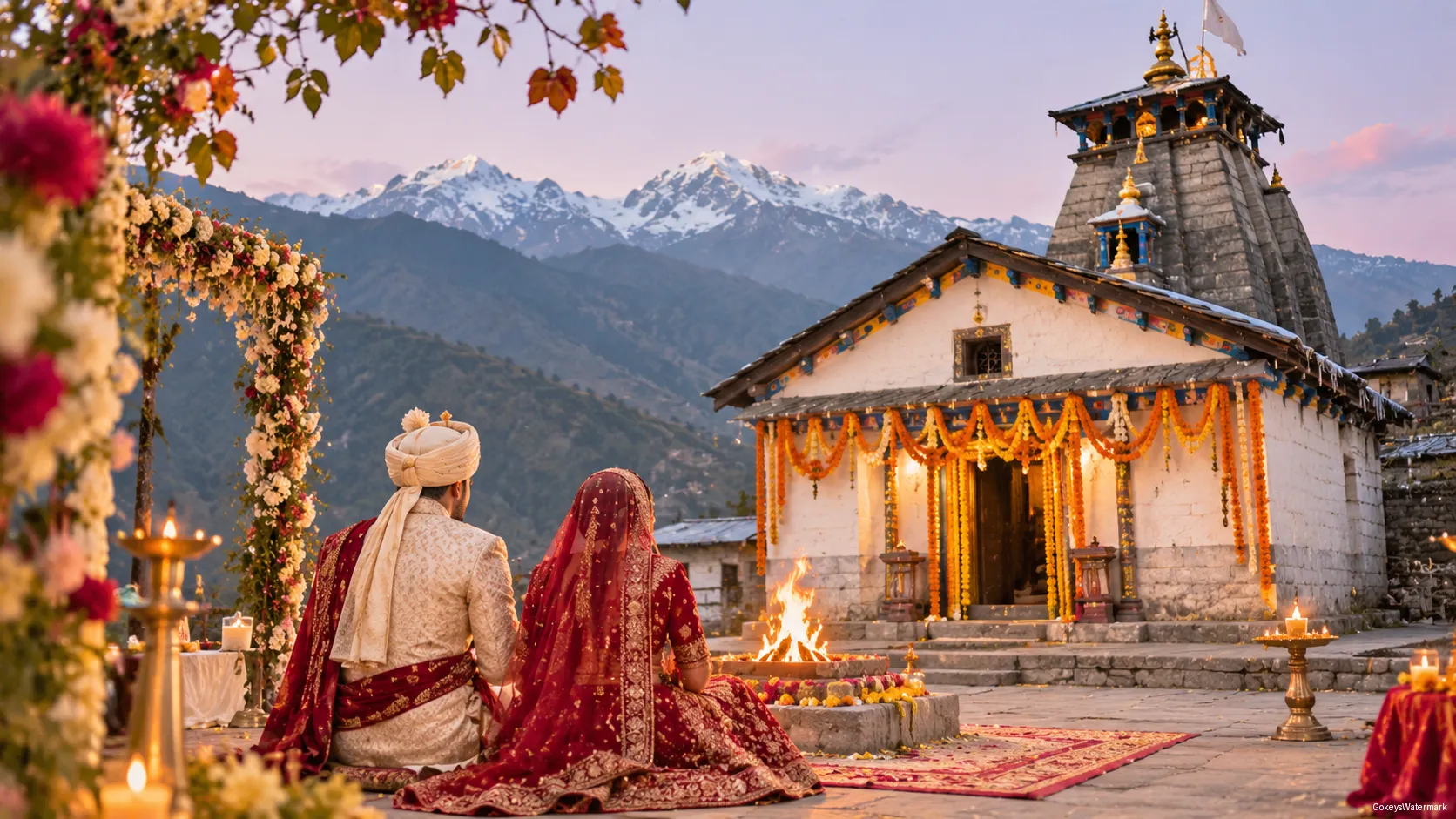
Before the road to Triyuginarayan climbs out of Sonprayag, there is a stretch where the Mandakini runs loud beside you and the valley closes in. Then the village opens up: stone houses, terraced fields, woodsmoke, and a temple courtyard where a small fire is said to have been burning for ages. Couples who have chosen to marry here describe the same feeling. It is not a wedding venue in the way a resort is a wedding venue. It is a place where the ceremony is the point, and everything else bends around it.
This guide is for couples and families who are seriously thinking about a Triyuginarayan temple wedding. It explains why the temple matters, when it is practical to marry there, what the rituals look like, what the limits are, where guests stay, how to get there, and what a trip like this realistically involves. Because rules around temple weddings in the hills are still being shaped, we have been careful throughout to separate what is well established from what you must confirm directly with the temple committee before you commit.
Why Triyuginarayan is a wedding place at all
The temple sits in Triyuginarayan village in Rudraprayag district, in the Garhwal Himalaya. Tradition holds that this is where Shiva and Parvati were married, and the name itself points to it: "tri" meaning three, "yugi" meaning ages, "narayan" referring to Vishnu, who is said to have presided over the wedding as Parvati's brother. The most striking part of the story is the sacred fire. Devotees say the fire lit at that divine wedding is still kept burning in front of the temple, and pilgrims bring wood to feed it and take a little ash home.
For a couple, that is a powerful idea. Most Hindu weddings take place around an agni, the sacred fire, and the pheras are taken around it. To take them around a fire believed to be a witness of the original wedding is, for many families, the closest thing to a perfect setting for the ceremony. It is the reason this temple has quietly become one of the best-known wedding places in the state, and the reason the state tourism and temple authorities have been promoting it as a destination for weddings.
We already have a short page on the temple itself, the Triyuginarayan Temple sightseeing page, which covers the temple's story and visiting details. This guide goes further and focuses on the wedding.
The best time for a wedding at Triyuginarayan
The practical answer is the colder half of the year. Authorities and temple bodies have been promoting Vedic weddings at Triyuginarayan between about November and April, which is when the nearby Kedarnath shrine is closed for the winter and the pilgrim rush on the valley is much lighter. That quieter season is better for weddings for obvious reasons: the roads and lodgings are less crowded, the village is calmer, and a wedding party does not compete with thousands of pilgrims.
Cold is the trade-off. At this altitude, winter evenings are genuinely cold, and snow on the higher road sections is possible. If you marry in December or January, plan for heavy woollens under the wedding outfits, heaters at every stay, and travel buffers in case a stretch of road is closed for a few hours. March and April are gentler and, for many families, the most comfortable of the window. November, at the start, often brings clear days and manageable cold.
The monsoon months of July to September are a poor choice. Heavy rain in the Mandakini valley brings landslides and road closures, and most wedding planners would advise against bringing a guest party up at that time.
Whatever month you choose, the exact date is guided by the priest and the almanac. Auspicious dates change from year to year, so confirm them before you book anything non-refundable.
What a Triyuginarayan wedding actually looks like
It helps to be honest about the scale. This is a village temple, not a banquet hall. Reports of how many guests the temple can hold vary; some accounts speak of around twenty to thirty people inside the temple precincts at a time, and a proposed set of norms for weddings has talked of keeping the wedding party to a limited size, in the region of fifty. These norms were described as draft in the material we have seen, so treat every number as something to confirm with the temple committee, not as a fixed rule.
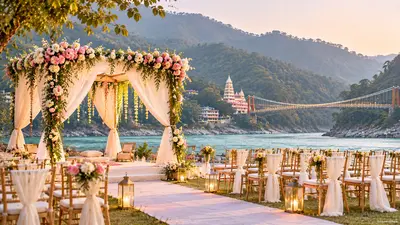
What that means in practice is that a Triyuginarayan wedding is intimate by design. Couples who go there generally bring close family and a few friends, not a three-hundred-person guest list. If you want a large reception, the usual approach is to hold the wedding at the temple and a separate reception or celebration elsewhere, for instance in Rishikesh, Dehradun or your home city, a few days later.
The proposed norms have also discussed discouraging loud elements that sit uncomfortably beside a temple, such as DJs, drones, firecrackers and brass bands, and moving pre-wedding functions like mehendi and sangeet to the lodgings and not the temple grounds. Again, confirm what is currently in force.
The ceremony itself follows a traditional Vedic pattern. A priest from the temple's tradition guides the couple through the key rites: the invocation of the deities, the sacred fire, the pheras around it, the vows and the offering of the sacred thread and sindoor. The couple usually arrives the day before, so that the evening can be used for a quiet preparation, and sometimes a smaller ritual such as a puja or a ritual bath takes place that morning. The details of ritual vary by family tradition and by the priest, which is why it is worth speaking to the priest well before you arrive.
We go into the ceremonial side in more depth in a separate post on Garhwali rituals and customs, which will follow this guide.
Where guests stay
The temple village itself has very limited accommodation, so almost every wedding party stays in the larger centres on the road toward it. The common choices are Guptkashi, Sitapur, Phata and Sonprayag.
Guptkashi is the largest and most comfortable base, with a good number of hotels and lodges, and it is a natural place for the wedding party to settle. Sitapur and Sonprayag are closer to the temple and the Kedarnath trail, and are practical for a smaller group that wants to be near the road head. Phata is a helicopter hub and a handy stop on the way. Our guides on where to stay on a Kedarnath trip and the Sonprayag and Gaurikund shuttle and parking guide give useful background on the area, because the same valley road serves both the pilgrim route and the wedding route.
Because hill hotels are small, a wedding party of thirty or forty will often be spread across two or three properties. This is one of the reasons to plan accommodation in writing and early. In the colder months, confirm heating, hot water and meal arrangements specifically, since those are the first things to fail in an overstretched hill lodge.
How to get there
The route is long and the roads are mountain roads, so plan the journey properly.
The nearest airport is Dehradun's Jolly Grant, roughly 230 km away by road. Rishikesh is a little over 240 km away and the drive takes around nine to ten hours with stops. From Delhi, the road journey is commonly twelve to fourteen hours. Most wedding parties break the trip with a night in Haridwar or Rishikesh on the way up and travel the second day in daylight, ending at Guptkashi or a nearby base. Mountain driving after dark is slower and more tiring, particularly for older relatives.
The last stretch from the base towns to the temple is a short drive. Published sources give different distances from Sonprayag, so we do not quote one here. Your driver or hotel will know the exact distance and time for the day.
We cover the route in detail in a separate post on how to reach Triyuginarayan, to follow. For a wedding party, the key decision is vehicles: a mix of cars and a tempo traveller or small coach for the main party usually works better than many separate cabs, because hill parking is limited and a convoy that arrives together is easier to manage. Our cab services cover Uttarakhand routes, including Delhi, Haridwar and Rishikesh pickups.
What a Triyuginarayan wedding costs
Costs for temple weddings are harder to pin down than for resort weddings because "a wedding at Triyuginarayan" can mean very different things. A few published packages we have seen start at around one lakh rupees and rise to several lakhs, depending on the number of guests, the number of nights, the stay and the services included. Some tour operators advertise per-person prices for a short three-night trip. Temple booking for a wedding is approximately ₹30,000, which can rise if wedding puja items are included, and the pandit's fee is extra. In the Sitapur and Guptkashi belt, deluxe hotels generally work out to about ₹2,000–3,000 per person per day with stay, all meals and snacks.
Our honest advice is to treat any single published number as a starting point. The real cost is built from five things: the number of guests, the number of nights, the hotel standard, the vehicles and the services you want, such as décor, photography and catering. We break this down properly in our guide to Triyuginarayan wedding cost and packages.
How to book, and what to confirm first
The booking process for weddings at the temple is not as simple as clicking a button. Online sources describe the process in different ways, and the rules have been changing as the state works out its approach to temple weddings. In general terms, you will need to coordinate with the temple's priests and the committee that manages the temple, confirm the date in the almanac, and make sure your wedding party's travel and stay are locked before you commit.
Before you pay anyone, confirm directly with the temple committee and local administration:
- That your chosen date is available and auspicious.
- The current limit on the number of guests and the rules on music, décor and photography.
- The fees, if any, payable at the temple and to the priest, and how they are paid.
- Any documents the temple or the local authorities require from the couple.
- Whether pre-wedding functions are allowed on the temple grounds or must be held at your stay.
We walk through the practical steps in our guide on how to book a wedding at Triyuginarayan temple.
What Gokeys does, and what we leave to others
Gokeys is based in Haridwar, the gateway to the Garhwal Himalaya, and we run tours, cabs and hotel bookings in this region every day. For a Triyuginarayan wedding we plan the trip around the ceremony so that the couple and family can concentrate on the ritual.
What we deliver ourselves: the full trip plan from Delhi, Haridwar or Rishikesh, cars and coaches for the whole wedding party, hotel selection and room blocks in Guptkashi, Sitapur or nearby, airport and station pickups, day-by-day coordination on the ground, and a plan for the stay and travel on either side of the wedding.
What we arrange through partners: priests and ritual arrangements, décor and flowers, catering, photography and videography. We manage these partners as part of your plan, so you have one point of contact.
What we do not do: we do not arrange temple permissions on your behalf in a way that replaces your own confirmation with the temple committee. We help you ask the right questions and keep the paperwork in order, but the final confirmation must come from the temple side.
A typical plan for a small wedding party might look like this. The most common shape is two nights and three days: the group leaves Haridwar on day one and spends the night in Sitapur or Guptkashi, the wedding takes place at the temple on day two with a quiet family meal at the stay that evening, and the party returns on day three.
Families who want a mehendi ceremony add one more day. Parties coming from Delhi usually add a night in Haridwar or Rishikesh before this. We can design a version of this for your date, your guest count and your budget. Send us a message through the contact page and we will prepare an itinerary and a quote.
Things to plan for that people forget
- Weather buffers. Add a spare day on either side of the wedding in the cold months.
- Altitude and health. Elders, young children and anyone with heart or breathing conditions should be comfortable with a long mountain drive and cold nights.
- Connectivity. Mobile signal can be patchy in the valley. Arrange the key contacts and a backup plan for the day.
- Dress. Wedding outfits need warm layers underneath, and comfortable footwear for temple courtyards.
- Food. Menus at small hill lodges are simple. If you want a particular wedding meal, arrange the caterer in advance and confirm cooking space.
- A reception elsewhere. If you want a larger celebration, plan it for Rishikesh, Dehradun or home. See our guide to a destination wedding in Rishikesh for one way to do it.