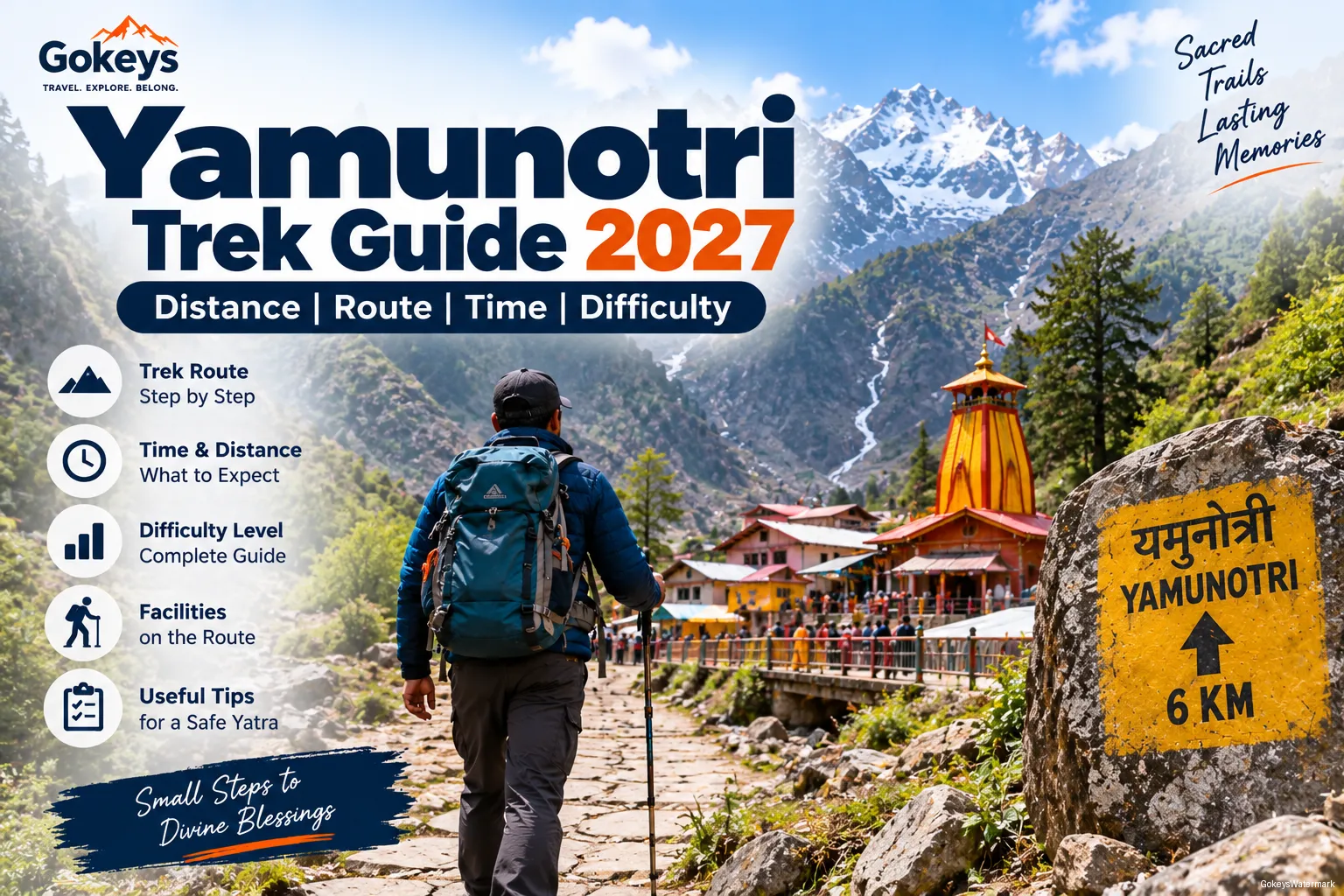
The Yamunotri trek starts at Janki Chatti and covers approximately 6 km one way, taking most people around 2 to 4 hours to walk up, depending on fitness, weather and crowd. You'll see this distance quoted as anywhere from 5 to 6 km depending on the source — more on why below — but 6 km is the figure used by the official Char Dham registration portal and is the safer number to plan around.
This guide covers the actual trek: the route, realistic timing, difficulty, and — something most guides skip — the walk back down.
Why You'll See Both "5 km" and "6 km" Online
Even sources with some claim to official standing don't fully agree. Uttarakhand Tourism's own destination page describes the trek as "5-6 km," while the official Char Dham Yatra registration portal consistently lists it as a 6 km trek across its route descriptions. An older Garhwal division government page states 5 km. Most current third-party travel guides settle on 6 km, occasionally 6.5 km when describing the specific route via Phool Chatti.
We plan around approximately 6 km for this reason — it's the figure used by the portal most directly tied to Char Dham trip planning, and it matches how most current operators describe the walk. If you see 5 km quoted elsewhere, it isn't necessarily wrong — it likely reflects an older reference point or a slightly different measurement convention — but 6 km is the safer number to prepare for.
Where Does the Yamunotri Trek Start?
Janki Chatti is the last motorable point on the Yamunotri route — this is where your road journey ends and the trek begins. Vehicles cannot go any further. Janki Chatti itself has parking, basic shops, places to eat, and is where pony, palki and porter services are booked for the trek ahead.
Yamunotri Trek Route: What to Expect
The trail follows alongside the Yamuna river for most of its length, on a paved, fairly wide path (commonly described as around 2 metres wide in places) that's well used during the season.
- The first stretch, in and around Janki Chatti itself, is relatively gentle, passing a GMVN rest house not far from the start.
- Once the town thins out, the trail becomes a proper mountain path — narrower in sections, continuously ascending.
- The route commonly passes through or near Phool Chatti on the way up.
- The final stretch toward the temple is the steepest part of the walk, which is exactly when most people are also the most tired.
It isn't a flat or gentle walk end to end — expect a steady, continuous climb rather than a mostly-level path with occasional inclines.
How Long Does the Yamunotri Trek Take?
Most people take somewhere between 2 and 4 hours to walk up, with some sources reporting up to 5 hours depending on pace, fitness and how many stops you take. A few things move this number:
- Crowd density during peak season (May–June) — the trail and the horse stand near Janki Chatti can get genuinely congested, which slows everyone down, not just slower walkers.
- Weather — rain makes the paved sections slippery and adds real time to your walk.
- Altitude effect — the temple sits at roughly 3,293 m, and most people notice their pace slow in the final stretch simply because of thinner air.
Don't plan your day around the fastest number you've read — build in a comfortable margin, especially if you're travelling with family or elderly parents.
Is the Yamunotri Trek Difficult?
It's generally rated as moderate, and for most reasonably fit adults it's manageable without technical skill. But "6 km" undersells what the walk actually asks of you.
Why a 6 km Mountain Trek Isn't Like a 6 km City Walk
A flat 6 km walk on level ground and a 6 km trek with continuous, steady ascent to over 3,000 m altitude are very different physical experiences. There's very little flat walking on this route — it's a sustained climb from start to finish, with the steepest section coming right at the end, after you've already been walking for a while. Add altitude, which reduces available oxygen and makes exertion feel harder than the same effort at sea level, and a "short" 6 km trek can feel considerably more demanding than the distance alone suggests.
Yamunotri Trek vs. Kedarnath Trek: A Quick Comparison
If you're doing both as part of a full Char Dham circuit, it helps to know how they compare. Yamunotri, at roughly 6 km one way, is significantly shorter than the Kedarnath trek, which runs closer to 16–20 km one way from Gaurikund (see our Kedarnath trek guide for full detail). Yamunotri is generally the more manageable of the two for most travellers, including many elderly pilgrims, simply because of the shorter distance — but it still involves a genuinely steep final stretch and real altitude gain, so "shorter" shouldn't be read as "easy."
Walking vs. Pony vs. Palki
- Walking is free and gives full control of pace, but is the most physically demanding option, especially on the final steep stretch.
- Pony cuts down physical effort and is commonly used on this route; it requires some balance and isn't ideal for anyone with back, hip or knee issues.
- Palki (a carried chair) is the most passive option, well suited to elderly travellers or anyone who can't walk or ride, though it costs more and needs to be arranged with porters.
All three are booked at Janki Chatti, generally at prepaid counters or union stands. We're not quoting a specific pony or palki rate here — the figures circulating online for this specific route aren't reliably consistent enough to repeat with confidence, and official 2027 rates haven't been announced in any case. Check the current displayed rate at the official counter in Janki Chatti on the day of travel, and always take a receipt.
Yamunotri Trek for Senior Citizens
Yamunotri is generally more manageable for elderly travellers than Kedarnath, mainly because of the much shorter distance. That said, the final steep stretch and the altitude gain are real factors — riding a pony requires balance and confidence mounting/dismounting, while a palki requires no physical effort from the passenger but costs more and needs advance arrangement, especially during busy periods.
Families travelling with older parents should decide on walking, pony or palki based on the individual's actual health and comfort level, not just cost. For broader planning around elderly travellers across the Char Dham route, see our guide to Char Dham with elderly parents.
What Time Should You Start?
An early start genuinely helps here, for a few concrete reasons:
- Crowd and pony congestion builds up through the morning during peak season — starting early means less time stuck in queues near the horse stand.
- Weather in the mountains tends to be more stable earlier in the day; afternoon cloud or rain is common.
- You need time for the return trek too — starting late compresses your whole day, including the walk back down and the drive back to your stay.
- Darshan timing — arriving earlier generally means a calmer temple experience before crowds build up.
If you're staying at Janki Chatti itself the night before, this is easier to manage than driving in from Barkot the same morning.
What's Available Along the Route
Basic tea stalls and small shops exist at points along the trek and around Janki Chatti and Phool Chatti, though don't expect anything beyond simple snacks and tea. Carry your own water rather than relying entirely on what you find en route. Toilet facilities exist at the main stops but are basic. As with most Himalayan pilgrim routes, facilities thin out the higher you get, so use what's available when you pass it rather than waiting until you specifically need it.
What to Carry
Keep this to a small day bag:
- A light jacket or windcheater — temperatures at 3,293 m are noticeably cooler than Janki Chatti, even in season
- Comfortable walking shoes with grip, for the paved but sometimes wet or uneven sections
- Water bottle and a few dry snacks
- Personal medicines
- ID and Char Dham registration
- Some cash for tea stalls, parking, or pony/palki booking
A full Char Dham packing list, covering the broader trip, is planned as a separate guide.
Weather: May–June vs. September–October
May–June is generally the busier, warmer window, with higher pilgrim numbers and correspondingly more congestion on the trail and at the horse stand. September–October tends to see fewer crowds and often clearer conditions, though temperatures are cooler. Monsoon months carry real risk of landslides and route disruption on the approach roads to Yamunotri — if you're travelling during this period, check current road and weather advisories from the district administration or Uttarakhand Tourism before starting your journey, rather than relying on a fixed assumption about conditions.
Reaching Yamunotri Temple, Surya Kund and Divya Shila
At the top, the main points of interest are the Yamunotri temple itself, Surya Kund — a natural hot spring near the temple where pilgrims traditionally cook rice as an offering — and Divya Shila, a rock pillar worshipped before entering the temple. Most visits involve darshan at the temple and a visit to these two points nearby; plan for some time here beyond just the walk up, since this is the actual purpose of the trip.
The Return Trek: Don't Plan Only for the Way Up
This is worth repeating because so few guides mention it: after your darshan, you still have to walk back down the same 6 km to Janki Chatti. Downhill walking on a paved mountain trail puts real strain on knees, and by this point you're likely tired from the climb, the altitude, and the time spent at the temple. Don't assume the way down will simply be quicker and easier — budget real time and energy for it, especially for elderly travellers or anyone using a pony (riders often still walk down more than they expect, depending on availability and arrangement).
After the Trek: Getting Back to Your Stay
Once you're back at Janki Chatti, most itineraries involve driving back toward Barkot, Kharsali, or staying closer at Janki Chatti itself, depending on your overall plan. Each of these bases works differently depending on whether you're prioritising an early next-day start, proximity to the trek, or a wider choice of accommodation — we've got a dedicated comparison of Barkot, Kharsali and Janki Chatti coming as a separate guide, and will link it here once published.
If you're planning the wider Char Dham circuit, our Char Dham Yatra itinerary and Char Dham Yatra package from Haridwar cover how Yamunotri fits into the full trip. If you're combining Yamunotri with Gangotri specifically, see our Gangotri–Yamunotri Do Dham package.
Check Char Dham Yatra 2027 Guide to prepare your trip.
Official 2027 pony/palki rates, registration rules and any route changes have not yet been announced and will be confirmed closer to the season.