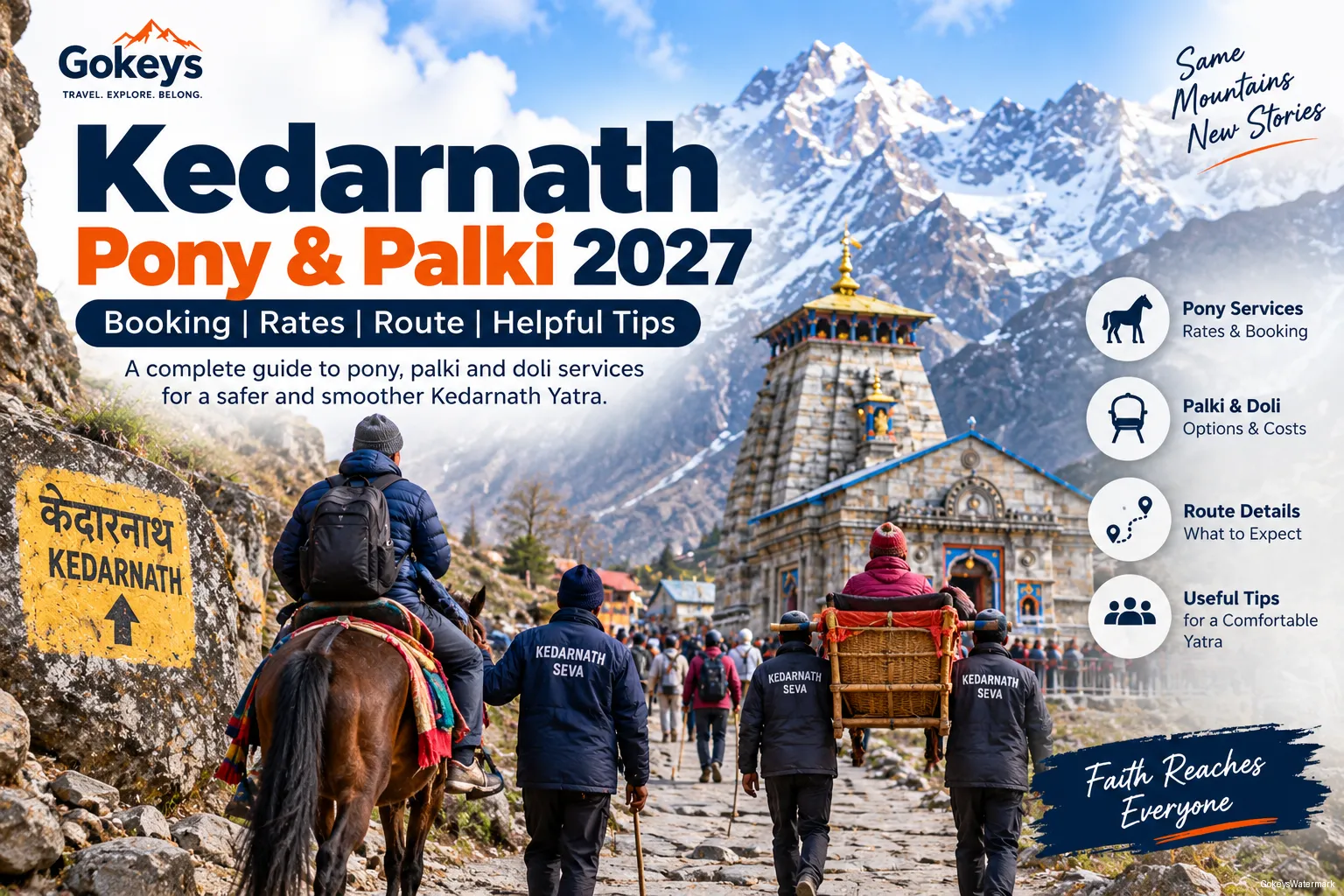
Pony and palki services for Kedarnath both start at Gaurikund, not Sonprayag, and both are booked only in person at government-authorised counters — there is no official online booking for either. Rates are fixed and revised each season by the Rudraprayag district administration, and the only number that actually matters is the one printed on your counter receipt on the day you travel — not any figure you read online beforehand.
This guide explains where these services start, how booking actually works, why the rates you find online disagree with each other so much, and how to avoid getting overcharged.
Where Do Kedarnath Pony and Palki Services Start?
Pony, palki and kandi (porter-basket) services all begin at Gaurikund, the point where the road ends and the Kedarnath trek begin. They do not start at Sonprayag. Sonprayag is a separate road-transfer point roughly 5 km before Gaurikund, connected by a local shuttle — we've covered that topic separately in our Sonprayag to Gaurikund guide. You'll book your pony or palki only after you've completed that transfer and arrived at Gaurikund. Counters also exist further along the route at points like Bhimbali and Linchauli, but Gaurikund is where most pilgrims book for the full distance.
For the trek route itself — distance, stops, difficulty — see our Kedarnath trek guide.
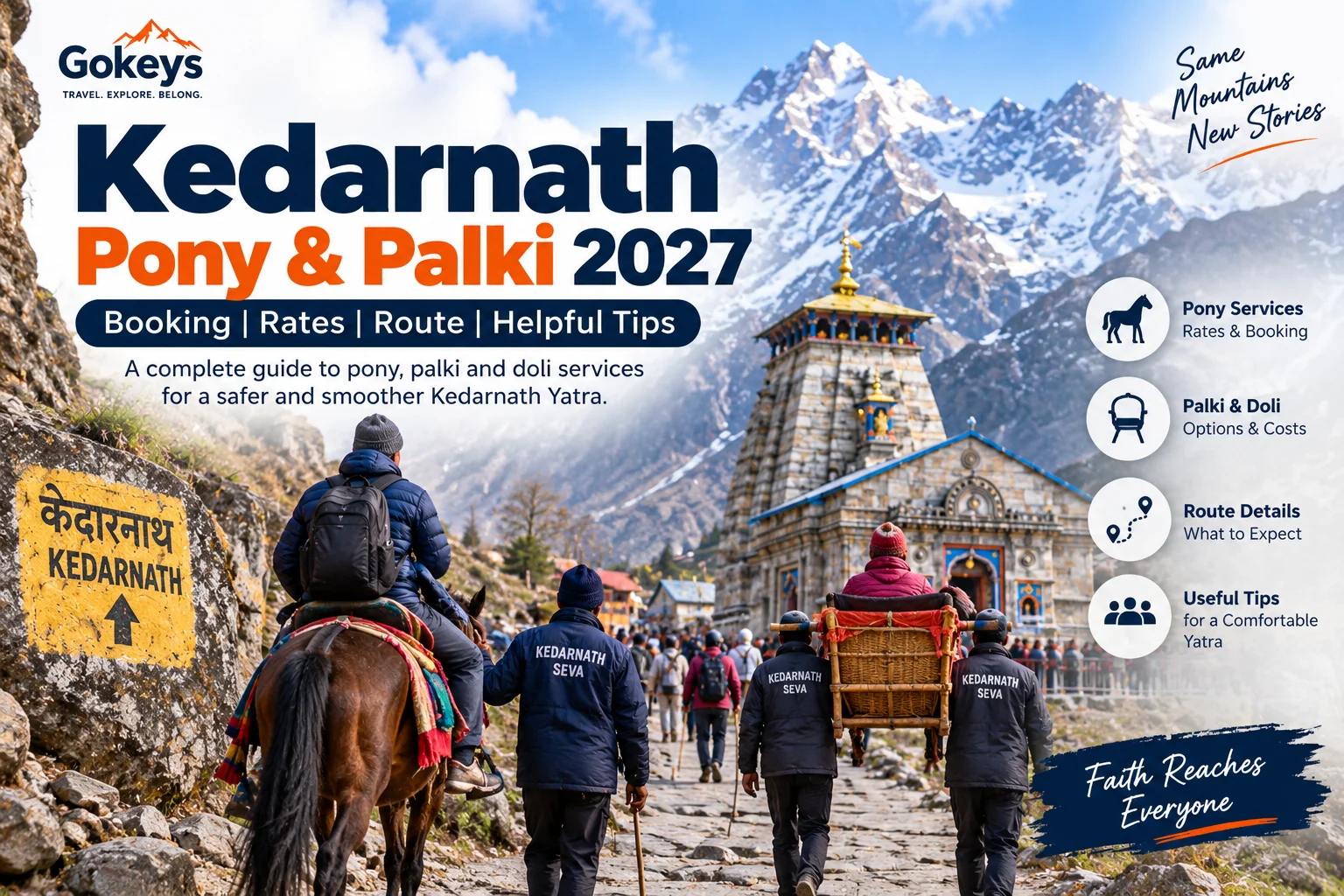
How Much Does a Kedarnath Pony Cost?
Why You'll See Very Different Numbers Online
If you search for "Kedarnath pony price," you'll find genuinely conflicting figures being presented as official — some pages quote a one-way pony rate as low as ₹1,050–₹1,500 (usually for shorter distance like Bhimbali or Linchauli to Kedarnath, not the full Gaurikund distance), others quote ₹2,500–₹3,500, others a flat ₹3,500, and a few quote ₹5,500–₹7,000 for the full Gaurikund–Kedarnath one-way trip. Several of these sources each claim to be reporting "the official government rate."
This isn't just sloppy reporting — a few real factors explain some of the spread: rates differ by starting point (Sonprayag-adjacent counters vs. Gaurikund vs. mid-route points like Bhimbali), the district administration revises rates through the season, and weight can push the price up. But the spread is wide enough, and some of the "official" figures contradict each other closely enough in timing, that we don't think any single number circulating online right now should be treated as reliable without checking it at the counter on the day.
2026 Season Rates (For Reference Only — Not 2027 Confirmed)
Based on the range of figures being reported for the 2026 season, a Gaurikund–Kedarnath one-way pony ride has commonly fallen somewhere in the ₹2,500–₹4,500 range for most riders, with some sources quoting higher. Treat this only as a rough planning range for what pony rides have cost recently — not as the confirmed 2027 rate. Official 2027 pony rates have not yet been announced and will be fixed by the Rudraprayag district administration closer to the season.
How Much Does a Kedarnath Palki Cost?
Palki (a covered chair carried by porters) is consistently the most expensive ground option. For the 2026 season, reported one-way rates for a Gaurikund–Kedarnath palki for a passenger under the baseline weight have ranged roughly from ₹8,000 to ₹12,000, though a few sources quote lower or higher figures outside this band. Again, this is indicative of the recent season only. Official 2027 palki rates are not yet announced.
Why Weight Matters for Palki and Kandi Pricing
Palki and kandi (porter-basket) rates are typically set for a baseline passenger weight (commonly reported around 60 kg), with additional charges applying above that. This is because the physical effort for the four porters carrying a palki scales directly with weight over a 16–20 km mountain route — it isn't an arbitrary surcharge. If you're booking a palki, expect the counter staff to ask or note passenger weight before quoting the final price.
Pony vs. Palki: What's the Real Difference?
- Pony requires the rider to balance in the saddle for several hours over an uneven, steep path. It's faster and cheaper than palki, but it demands some physical stability and confidence, and isn't ideal for anyone with back, hip, or knee conditions that make mounting, dismounting, or sustained riding difficult.
- Palki keeps the passenger seated and carried the entire way, requiring no physical effort or balance from the traveller. It costs more and needs four porters, which is part of why it's priced higher, but it's the more passive and often safer option for elderly travellers or anyone who genuinely cannot walk or ride.
- Kandi/pitthu (a porter-carried basket) is generally used for smaller or lighter passengers (often children) or for carrying luggage rather than as a primary option for adult pilgrims.
For the walking option and full route detail, see our Kedarnath trek guide.
How to Book a Kedarnath Pony or Palki
Is There Online Booking?
No. Despite "kedarnath pony booking online" being a common search, there is currently no official online booking system for pony, palki or kandi services. Booking happens in person at the government-authorised counters on the day of travel. Be cautious of any website or agent claiming to offer advance online booking for these specific services — this is a common area for scams.
Step-by-Step at the Counter
- Reach Gaurikund after completing your Sonprayag transfer and registration check.
- Go to the official prepaid counter, not an operator standing outside the queue. Counters are typically clearly marked and run by the local union/administration.
- State your requirement — pony or palki, one-way or round trip — and your approximate weight if asked (relevant for palki/kandi pricing).
- Pay at the counter and collect a printed receipt or slip. This should show the rate charged and, for pony, typically the animal's registration number.
- Match your rider/porters to the receipt. Confirm the details on your slip correspond to the person actually taking you before you start.
- Keep the receipt with you for the duration of the ride in case of any dispute.
Kedarnath Pony for Senior Citizens
Pony riding requires the rider to hold balance over a long, uneven mountain path for several hours — manageable for many seniors in reasonable health, but genuinely difficult for those with significant back, hip, knee, or balance issues, or anyone unsteady mounting and dismounting a horse repeatedly at rest points.
Palki is generally the more suitable option for elderly travellers who cannot walk the full distance but also shouldn't ride — it requires no balance or physical exertion from the passenger, though it does cost more. Families travelling with elderly parents should discuss both the health condition and personal comfort level honestly before deciding, rather than assuming pony is automatically the "easier" option simply because it's cheaper. For broader planning around elderly travellers on the Char Dham route, see our guide to Char Dham with elderly parents.
If a doctor has advised against strain at altitude, discuss the trip with them specifically — pony and palki reduce physical exertion but don't eliminate altitude effects.
Avoiding Unofficial Agents and Overcharging
- Book only at the marked government counter, never from someone approaching you in the queue or parking area with a "better rate."
- Always take a printed receipt. This is your main protection if a rider or porter later asks for more money than agreed.
- Check that the pony is registered — a numbered jacket or tag is typically used to identify authorised animals; avoid unregistered/unmarked ponies even if offered at a lower price.
- Don't pay the full fare in advance to someone away from the counter, and don't negotiate informally on the trail for a fresh booking.
- If you're overcharged or misled, report it on the spot to the tourist police booths typically present at Sonprayag and Gaurikund, rather than trying to resolve it after the fact.
Return Journey: How It's Arranged
If you need a pony or palki for the return leg as well, this is generally arranged as a separate booking (round-trip pricing, where offered, is usually a defined package rather than the same rider being automatically available on your way down). Confirm at the time of your original booking whether you're booking one-way or round-trip, and get this reflected clearly on your receipt. Don't assume the same pony or porters will be available or committed to your return time unless that's explicitly what you paid for.
Safety Considerations
- Weather changes quickly on this route — a fine morning can turn wet or windy by afternoon, which affects both pony and palki comfort and safety.
- Give way to pony and mule traffic on narrow stretches whether you're walking or riding.
- If you feel unwell — dizziness, breathlessness, chest discomfort — say so immediately rather than continuing; riders and porters along this route deal with this regularly and can help you stop safely.
- Keep basic emergency numbers accessible: police/medical emergency 112, and the SDRF helpline 1070 for Uttarakhand disaster response — confirm current contact numbers through the official Uttarakhand Tourist Care portal before your trip, since helpline details can be updated.
If you'd prefer the pony/palki booking guidance handled alongside your full Kedarnath trip planning, hotels and route, see our Kedarnath Yatra package from Haridwar.
Want to know about Char Dham Yatra 2027?
Official 2027 pony, palki and kandi rates have not yet been announced by the Rudraprayag district administration. The figures above reflect a range commonly reported for the 2026 season and are for planning reference only — always confirm the rate printed at the official counter on your date of travel.