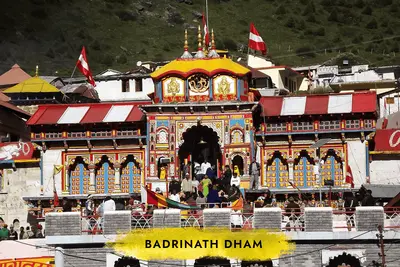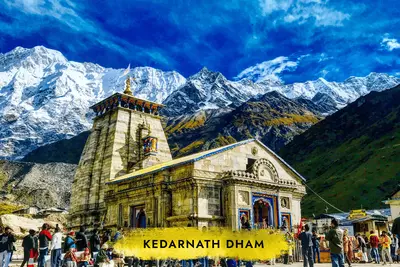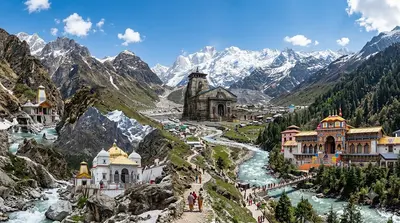
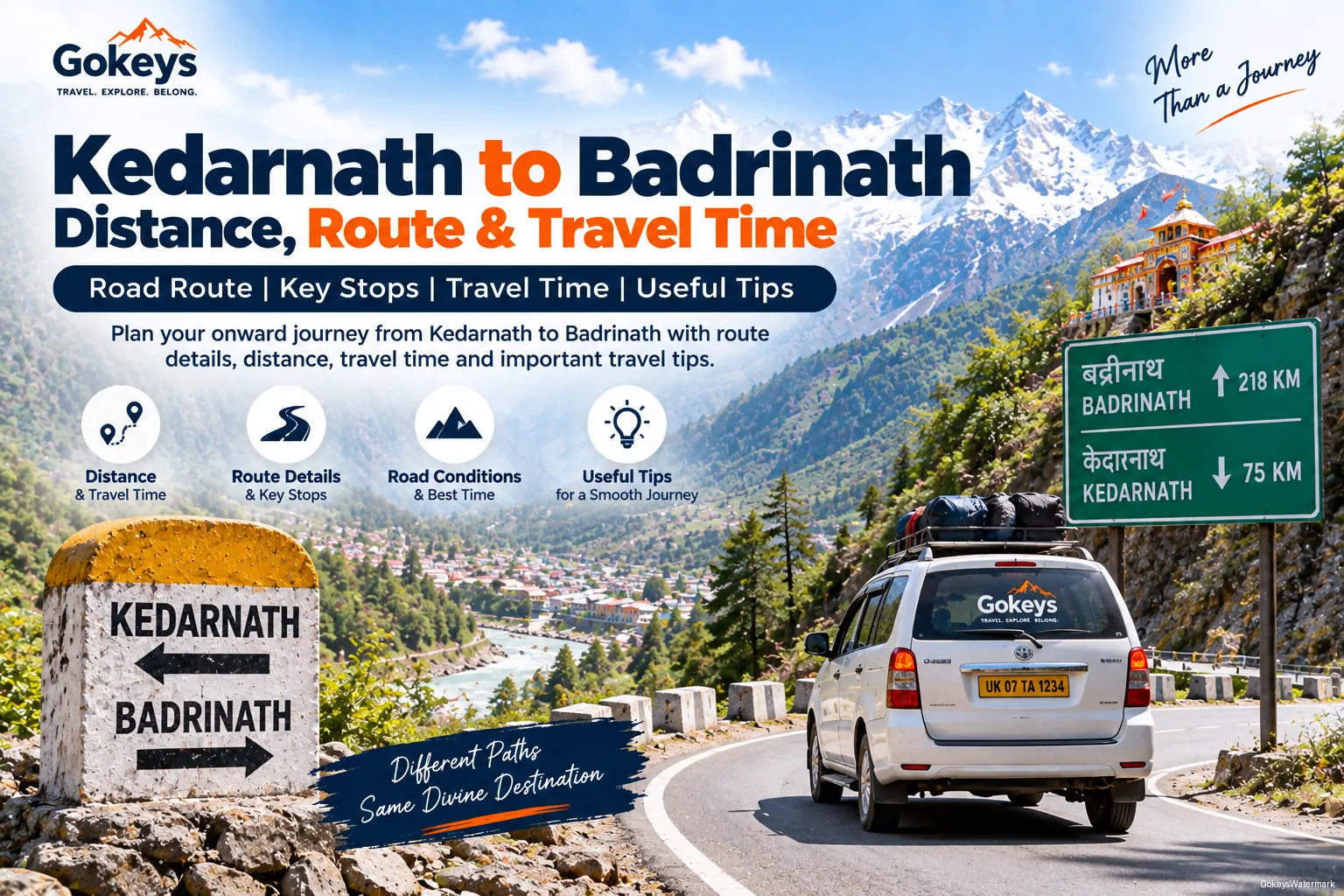
There's no road from Kedarnath Temple — so "Kedarnath to Badrinath distance" isn't really one number. The actual journey has two very different parts: getting back from Kedarnath to the road head (on foot, pony, palki, or helicopter), and then a road journey of roughly 215–225 km from Sonprayag to Badrinath, via Rudraprayag, Karnaprayag and Joshimath, typically taking 6–7 hours in good conditions.
This guide breaks the journey into its real stages, gives a properly reasoned answer on same-day feasibility, and covers the practical planning decisions — trip length, intermediate stays, and transport — that a single distance figure can't tell you.
Can You Drive Directly from Kedarnath to Badrinath?
No. Kedarnath Temple has no motorable road connection at all. Every pilgrim, regardless of how they plan to travel onward, must first get back to Gaurikund (the trek starting point) and then to Sonprayag (the point where private vehicles are allowed again), before any road journey toward Badrinath can begin.
Step 1 — Returning from Kedarnath to Gaurikund
This leg can be covered on foot, by pony, by palki, or by helicopter, depending on how you arrived and what you'd prefer for the return. This is the same route covered in detail in our Kedarnath trek guide (distance, difficulty, timing), our pony and palki guide (booking, rates), and our Kedarnath helicopter booking guide (booking process, helipads). We won't repeat that detail here — but it matters for this journey because how you descend directly affects what time you're realistically ready to start the road journey toward Badrinath.
Step 2 — Gaurikund to Sonprayag
From Gaurikund, a local shuttle arrangement covers the roughly 5 km back to Sonprayag, where private vehicles are permitted again (private vehicles aren't allowed beyond Sonprayag during the Yatra season). We've covered this transfer — including timing and what to expect — in our Sonprayag to Gaurikund guide.
Step 3 — Sonprayag/Guptkashi to Badrinath by Road
This is where the actual road journey begins. From Sonprayag (or nearby Guptkashi, depending on where your vehicle is based), the standard route to Badrinath runs via Rudraprayag → Karnaprayag → Nandaprayag → Chamoli → Joshimath → Badrinath, broadly following NH58/NH107. The road distance for this stretch is approximately 215–225 km, and it's commonly quoted as a 6–7 hour drive in good conditions — though during pilgrimage season, with traffic, meal stops and road conditions factored in, it often takes longer in practice.
An alternate route via Ukhimath and Chopta also exists and is used by some travellers, with a broadly similar total distance — but the Rudraprayag route above is the one most commonly used for this leg.
Kedarnath to Badrinath Route Sequence
Putting it all together:
Kedarnath → (trek/pony/palki/helicopter) → Gaurikund → (local shuttle) → Sonprayag → (road) → Rudraprayag → Karnaprayag → Nandaprayag → Chamoli → Joshimath → Badrinath
Only the last stretch, from Sonprayag onward, is an actual road distance you can measure and drive continuously.
How Long Does the Full Journey Take?
Break it down into its real components rather than expecting one number:
- Kedarnath to Gaurikund: several hours if walking (see our trek guide for realistic timing), less by pony or helicopter.
- Gaurikund to Sonprayag: a shorter local transfer, but can involve queuing time depending on how busy it is.
- Sonprayag to Badrinath by road: approximately 6–7 hours in good conditions, though pilgrimage-season traffic, weather, road works, or landslide-related delays can extend this meaningfully.
Add these together realistically, plus meal and rest stops, and you'll see why there's no single reliable "X hours from Kedarnath to Badrinath" figure that applies to everyone — it depends heavily on how you descend, what time you start, and current road conditions.
Can You Reach Badrinath the Same Day After the Kedarnath Trek?
Technically yes, but it's a genuinely demanding day, and whether it's a good idea depends on your specific situation. Consider:
- What time you leave Kedarnath. An early descent (starting near sunrise) gives you the best chance of reaching Sonprayag with enough of the day left for the long drive.
- How you descend. Walking down is more physically tiring than pony, palki, or helicopter, and that fatigue carries into a 6–7+ hour drive afterward.
- Transfer delays. Queuing at Gaurikund or Sonprayag can eat into your remaining daylight.
- Daylight and road safety. Mountain roads toward Joshimath are not roads you want to be driving after dark if avoidable.
- Traffic and road conditions, which can add hours during peak season.
For many travellers, especially those walking the Kedarnath trek both ways, an intermediate overnight stop — rather than pushing straight through to Badrinath the same day — produces a considerably more comfortable itinerary. This isn't a rule, just a realistic planning consideration worth weighing honestly rather than assuming a same-day push will always work out.
Where to Stay Between Kedarnath and Badrinath
This is specifically about stops on the road journey itself, not Kedarnath-side accommodation (covered separately in our Where to Stay for Kedarnath guide). Depending on your pace and how the day has gone, towns along the Rudraprayag-Karnaprayag-Joshimath route — such as Rudraprayag or Chamoli — are commonly used as a practical overnight break, splitting a long single-day drive into two more manageable stretches. Different itineraries use different towns depending on what time the Kedarnath leg finishes and how the operator or traveller wants to pace the remaining distance to Badrinath.
5-Day vs. 6-Day Kedarnath–Badrinath Trip
A tighter 5-day itinerary generally means less buffer — a same-day or near-same-day push from Kedarnath toward Badrinath, with limited slack for weather, fatigue, or delays. A 6-day itinerary typically builds in that intermediate overnight stop, giving the Kedarnath descent, the long drive, and the Badrinath visit each proper room rather than compressing them. Neither is objectively "correct" — it depends on your available time, physical comfort with long travel days, and how much buffer you want against weather or road disruption. The extra day mainly buys comfort and flexibility, not new sightseeing.
Kedarnath to Badrinath by Taxi
A "Kedarnath taxi" doesn't mean pickup at the temple — your taxi or private cab will be waiting at Sonprayag (or wherever it dropped you before the trek), not any closer. If you're on a private cab arrangement, confirm in advance where exactly your vehicle will be positioned for the return leg, since this affects how quickly you can start the road journey once you're back from Kedarnath. We're not quoting specific fares here, since these vary by vehicle type, season and operator — check current rates with your driver or operator directly.
Kedarnath to Badrinath by Bus
We did not find reliable evidence of a direct, dedicated Kedarnath-to-Badrinath bus service. Public transport on this route generally involves reaching Sonprayag or Rudraprayag first and then connecting onward, likely with a change or two, rather than one continuous bus journey. If you're relying on public transport for this leg, build in extra time and flexibility rather than assuming a single direct service exists.
Kedarnath to Badrinath by Helicopter
There's an important distinction here. The Kedarnath-sector helicopter service (covered in our Kedarnath helicopter booking guide) flies between Kedarnath and helipads at Guptkashi, Phata or Sersi — it does not fly onward to Badrinath. A genuinely separate product, the full Char Dham helicopter circuit, covers all four dhams as a multi-day package, typically based out of Dehradun — that's a different itinerary structure entirely, not a short Kedarnath-Badrinath hop. We didn't find evidence of a scheduled direct Kedarnath-to-Badrinath helicopter service, so this shouldn't be assumed.
Best Approach for Families and Elderly Travellers
The Kedarnath descent followed by a long mountain drive is genuinely tiring, even more so for families with young children or elderly travellers. An intermediate overnight stop between the two temples, rather than a same-day push, generally makes for a more comfortable pace. If you're on a private cab, you have flexibility to adjust timing and stops as needed; if you're on a fixed group itinerary, the overnight structure is usually already built in. For broader planning around elderly travellers on the Char Dham route, see our guide to Char Dham with elderly parents.
Road Conditions to Expect
This stretch runs through genuine Himalayan mountain terrain — expect continuous curves, and be aware that landslides, weather disruption, and periodic road works are all realistic possibilities, particularly during monsoon months. Pilgrimage-season traffic can also add real time beyond what a map's estimate suggests. For current road status, check official district administration or Uttarakhand Tourism advisories close to your actual travel date rather than relying on general seasonal assumptions — conditions can change quickly and temporarily.
Useful Stops Along the Way
- Rudraprayag — a natural rest/meal point and common overnight option, sitting at the confluence of the Alaknanda and Mandakini rivers.
- Karnaprayag — another river-confluence town along the route, useful as a waypoint or shorter rest stop.
- Chamoli — commonly used as an intermediate overnight stop for travellers splitting the journey into two days.
- Joshimath — the last major town before the final climb to Badrinath, often used for a short break before the final stretch.
A Practical Kedarnath–Badrinath Itinerary Example
A simple 6-day pattern: complete the Kedarnath darshan and descend to Sonprayag, overnight at or near Rudraprayag/Chamoli to break up the long drive, then continue to Badrinath the next day for darshan, with a return journey to follow. This spreads the demanding parts of the trip — the Kedarnath trek and the long road journey — across separate days rather than compressing them.
If you'd prefer this entire journey — Kedarnath, the road leg, Badrinath, hotels and transport — planned and arranged for you, see our Kedarnath–Badrinath Do Dham package.
Do Dham vs. Full Char Dham
A Kedarnath-Badrinath Do Dham trip makes sense if your time or priorities are focused on these two temples specifically. If you have more time available and want to cover all four dhams, this same route logic extends further — see our Char Dham Yatra itinerary and Char Dham Yatra package from Haridwar for how the full circuit is typically structured.
Read more about Char Dham Yatra 2027 Complete Guide
Road conditions, temporary restrictions, and any 2027 changes to routing or timing are not covered here since they haven't been officially announced — check current advisories close to your travel dates.